
Driving Forktrucks
Safely
Your personal learning platform
Load tables
Load table are the only way to find out how much you can lift without overloading the forktruck.
Every forktruck has its own individual load table. Normally, you can find it attached next to the driver´s seat – here you can easily inspect it from inside the truck.
Most forklift driver´s hardly ever use a load table in their every-day routine – yet, it´s highly relevant for the exam. Why is this?
Imagine, you are working in a production line and repeatedly handle exactly similar goods. Would you check the load table every single time again? Probably not… We call this professional experience because we know by experience, that we can lift that very load safely with our truck.
Let´s imagine another situation: What happens when a new machine or unusual goods are delivered and you have to unload it from a truck? Right! This is when you will actually consider the load´s weight and center of gravity before comparing it with your load table. As an employee and owner of the proof of specialiced knowledge for forktrucks you must have sufficient knowledge to interprate multiple load tables in order to prevent an accident.
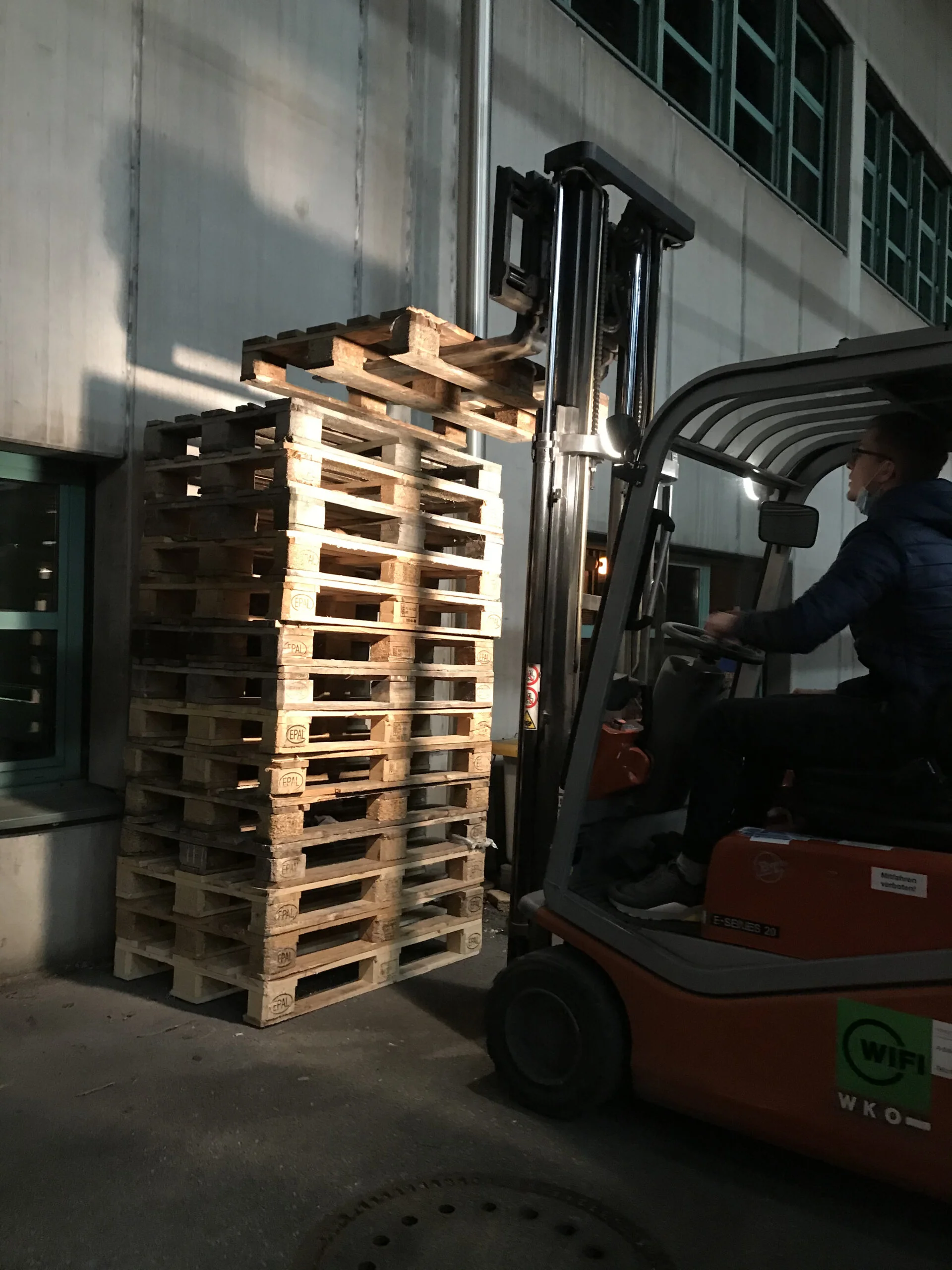
Practical training
A forklift license is legally quite different from a standard driver´s licence: Technically, it is called a proof of specialiced knowledge and only needed in an employee relationship. This is what often leads to a misconception of the course:
While the course clearly focuses on theoretical aspects and safety issues of driving forklifts, some people expect a practical training instead. While this may not be an entirely bad idea by practical means – the legal requirements define the course outline as mentioned above.
The only way to implement more practical training into the course is by extending the course time beyond the legal requirements – which would result in increased course fees. Good news is, that you can always arrange your personal practical training with the WIFI office.
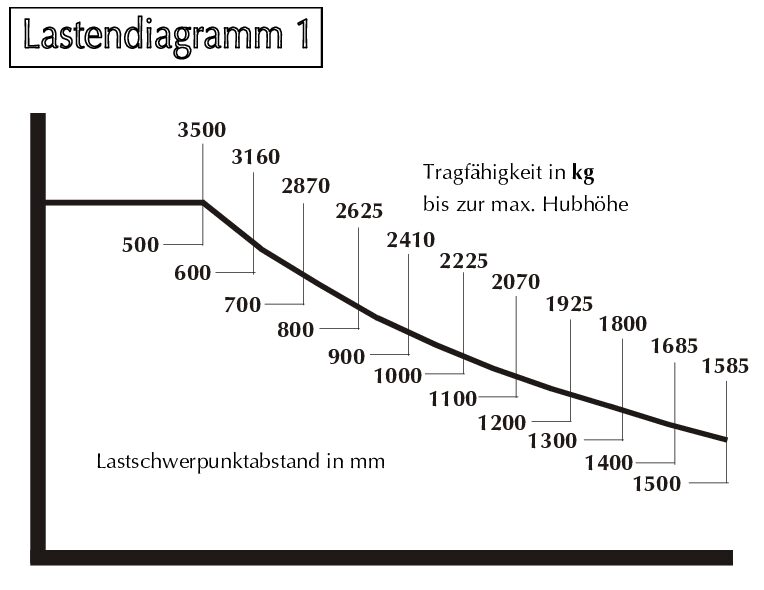
Diagram #1
Diagram #1 is fairly simple. It only contains the values for LSA and load capacity – they always come in pairs. This load table doesn´t refer to different lift heights, instead it refers to the maximum lift height of the truck. This way it´s easier to read then the other diagrams, but also limits the trucks load capacity when lifting on lower levels.
Diagram #2
In addition to the values for LSA and load capacity this digram also contains six references for the according lift height. The load capacity values for the according lift height are found in the same line – they are valid up to the designated lift height, but when you lift higher than that the next (higher) lift height applies.
By referencing different lift heights (instead of just the maximum lift height as in #1) the load capacity of the truck can be increased when lifting on lower levels.
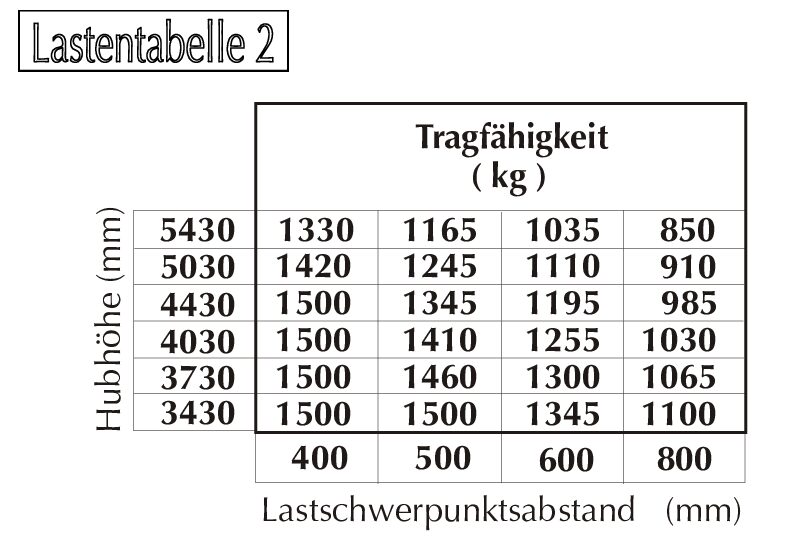
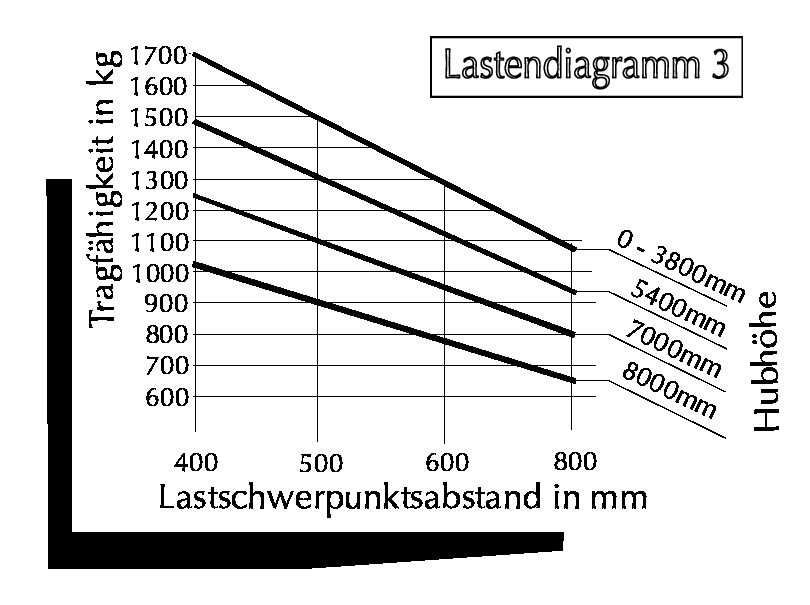
Diagram #3
Diagramm 3 ist zwar graphisch anders ausgeführt, beinhaltet aber exakt die selben Informationen wie Diagramm 2. Häufig sorgt es für Verwirrung, da die geringste Hubhöhe ganz oben im Diagramm eingezeichnet ist (ist aber logisch: je niedriger die Hubhöhe desto höher das zulässige Traggewicht).
Überall wo sich waagrechte (kg) mit senkrechten (LSA) Linien überschneiden entstehen sogenannte Schnittpunkte. Nur an diesen Punkten können die Werte für LSA und Gewicht abgelesen werden.
Die dicken schwarzen Linien sind sogenannte Höhen-Begrenzungslinien. Sie dienen ausschließlich dazu, das Diagramm zu begrenzen. Möchtest du beispielsweise eine Last 5m hoch heben, so endet dein Diagramm bei der 5400mm Linie. Es ist wichtig, dass du diese Linien beim Ablesen nicht verwechselst – verwende dazu ein Blatt Papier zum Abdecken der anderen Bereiche.
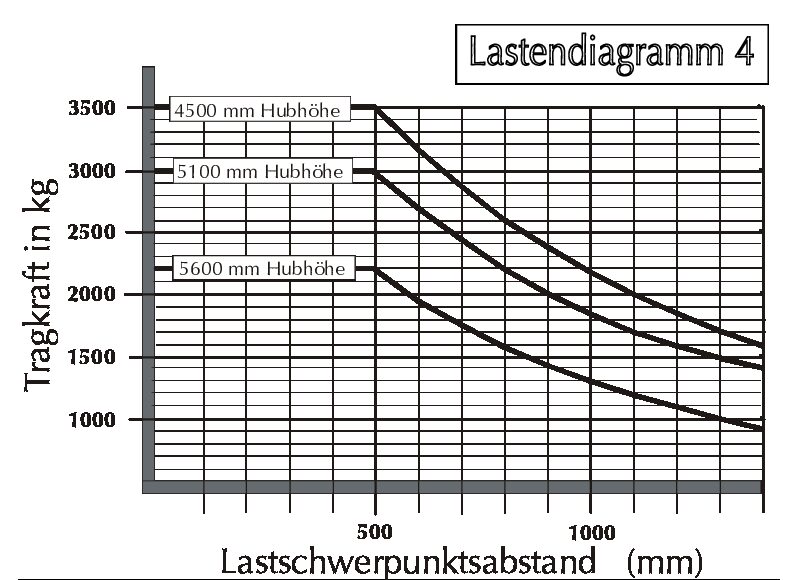
Diagram #4
Diagramm 4 unterscheidet sich nur optisch von Diagramm 3. Die Unterschiede: Höhenbegrenzungslinien sind nicht linear, sondern als Kurve dargestellt. Es gibt mehr Werte für Tragfähigkeit und Lastschwerpunktabstand – hier dürfen alle Linien verwendet werden (man zählt selbst in Schritten von 100). Der Vorgang zum Ablesen der Werte bleibt exakt wie bei Diagramm 3.
Need more?
Here you can find all questions and answers
relevant for the exam!